

Overview
This page records a pre-race strategy prediction for the 2026 Dutch Grand Prix (Zandvoort, round 12, 72 laps), produced on race morning (23 August 2026) by driving the interim strategy engine directly with a hand-assembled lap-0 input. It exists so the prediction can be judged against the race afterwards, and against what the live Race Strategy Tool produced once laps started settling.This was an investigation run, deliberately outside the Watchparty pipeline: nothing here was written to the platform database, no
model_version applies, and the output never reached the widgets. The engine was the interim build the live tool ran at the time (0.1.0-interim), run deterministically (single thread, fixed seed 42). The live tool has since moved on, so these figures are a record of that run, not of what the tool would predict today.Method
The run happened in two passes, using theprerace_green conformance case shape as the template.
Pass 1: starting-compound sweep. Three lap-0 cases were solved, identical except for every driver’s starting compound (Soft, Medium, Hard). The engine pins each strategy’s first compound to the starting tyre, so comparing the three variants’ best race times per driver reveals the optimal starting compound rather than assuming it.
Pass 2: mixed-field equilibrium. A single case with each driver on their pass-1 optimal starting compound, solved with a wider game-theory search so drivers counter-adjust to each other: 10 opponent-resample repeats per candidate, 3 full optimisation cycles across the field, and stop laps swept plus or minus 5 around each deterministic optimum. The game-theory stage took 349 seconds single-threaded.
Inputs
Assumptions: equal-thirds sector split of lap pace and fuel; 0.75 s stagger between grid slots at lap 0; degradation mapped linearly across the full race distance; hard-to-medium offset derived as 0.47 s; SC and VSC sector times scaled from the template convention (no safety cars assumed); track evolution folded into base pace.
Headline Findings
- Tyre freshness splits the field. Drivers still holding a fresh Medium plus fresh Hards optimise to a Medium start; drivers whose strength is fresh Softs optimise to a Soft start. Fourteen drivers start Soft, eight Medium, none Hard.
- The front five converge on a two-stop Medium-Hard-Hard (the McLarens, Mercedes pair and Leclerc, with Hamilton and Ocon on the same book further back).
- Verstappen’s is the attacking book: Soft-Soft-Medium, stopping laps 22 and 39. His fresh Soft, which most of the front group lacks, makes the aggressive two-stop his optimum and carries him past Hamilton to P6. Lawson is the field’s only one-stopper (Medium-Hard, lap 29), conserving Red Bull’s single fresh Hard.
- The game-theory pass differentiated the front. Near-identical deterministic M-H-H prescriptions split once drivers reacted to each other: Norris undercuts at 19 then runs long to 51, while Russell (24, 49), Antonelli (25, 48) and Piastri (23, 49) cover each other within a lap or two.
- The Soft-starting midfield opens with an undercut scramble, first stops clustered on laps 17 to 24, most converging on Soft-Soft-Medium with the second stop around lap 39.
Predicted Result
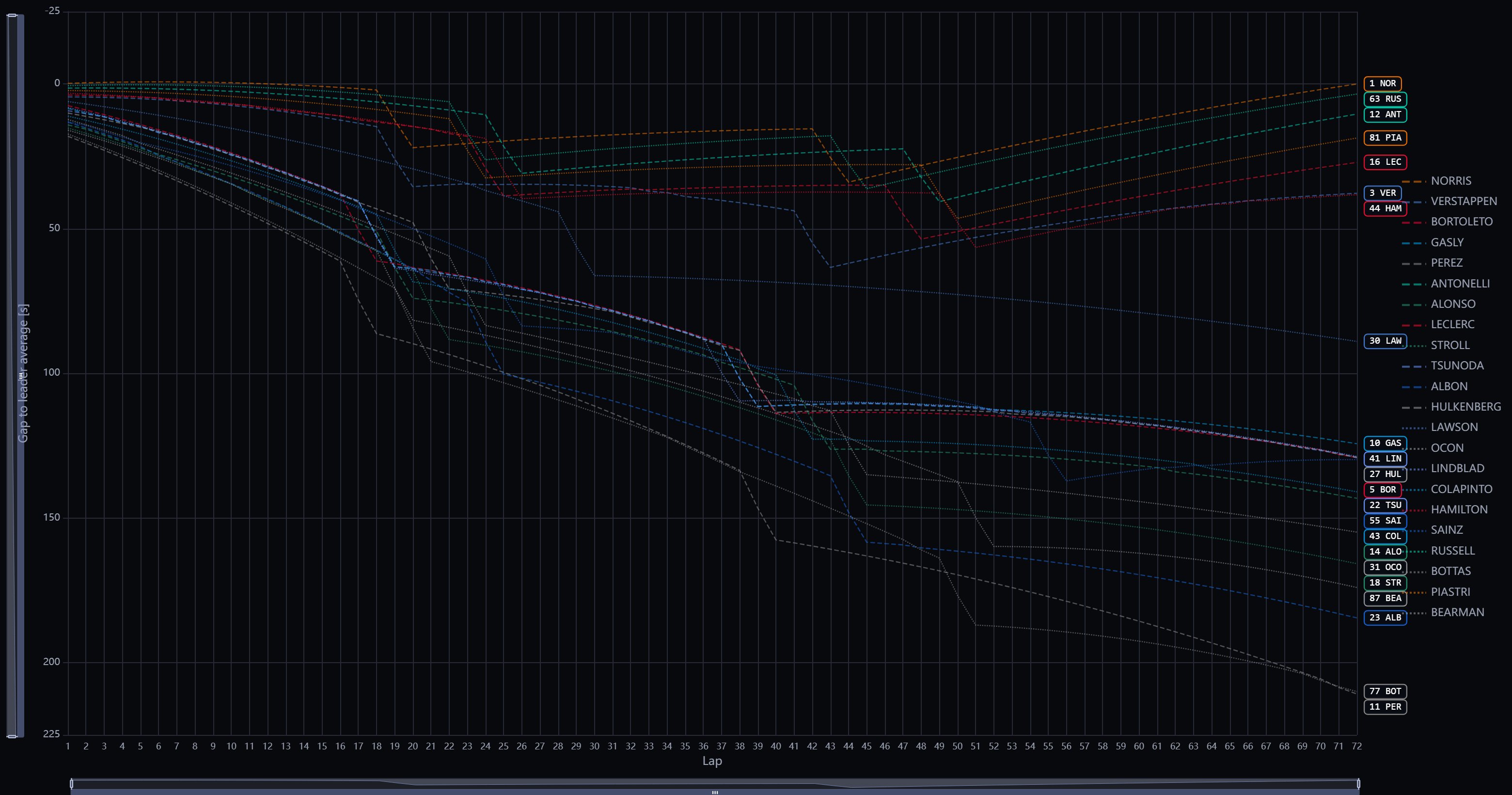
Tyre allocations were reconciled against the official Pirelli race allocation on race morning before this run; every driver’s available new and used set counts match the published books, so all 22 drivers appear in every pass-1 variant.
Caveats
- Degradation gradients and compound offsets are field-wide priors, so strategy differences between drivers come only from base pace, tyre allocations and grid position. Per-driver degradation would differentiate further.
- No safety car, VSC or rain scenarios were modelled.
- Game-theory probabilities are a uniform split, and the 3-cycle equilibrium has no convergence test: the stop laps are a 3-round answer, not a proven fixed point.
- Solver settings were an investigation choice (10 repeats, 3 cycles, plus or minus 5); production values remain an open question with the engine’s developer.
- Predicted gaps compound every assumption above; treat the ordering and strategy shapes as the reviewable claims, not the exact seconds.
Companion Investigation
A second run with sprint-derived degradation numbers (Soft 0.062, Medium 0.102 - Softs outlasting Mediums) flips the entire field to Soft starts and all-two-stop strategies while barely moving the finishing order. The two pages bracket the strategy space on the one input they disagree about; the alt-deg page’s “Reading the Two Runs Together” section says what to watch live to tell which was right.Review After the Race
Judge the prediction on four questions:- Starting compounds: did the fresh-rubber split (Soft midfield, Medium front) match the actual grid choices?
- Strategy shapes: two-stop M-H-H up front, one-stop Red Bull, early Soft undercuts behind; which survived contact with reality?
- Stop timing: actual first stops against the predicted lap 17 to 27 spread.
- Order: predicted versus actual classification, and both against the live Race Strategy Tool’s first solved laps (this run doubles as a benchmark for the live tool’s cold-start behaviour with priors).