

Architecture
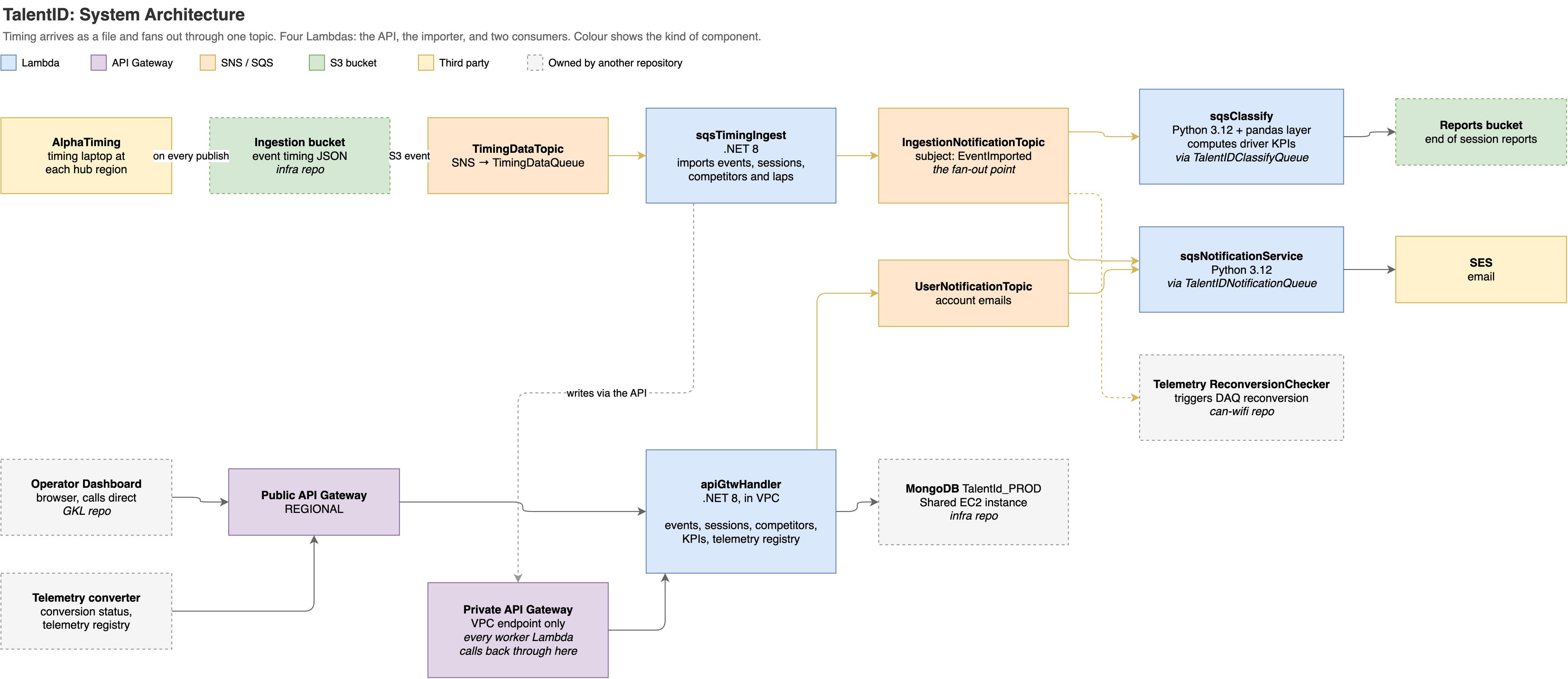
The diagram source is the draw.io file at
images/software/developer/estate/systems/talentid/architecture.drawio. To change the diagram, edit that source in draw.io, re-export it as PNG to architecture.png in the same folder, and commit both.The Shape Of It
Four Lambdas, one API in two flavours, and a single SNS topic that everything downstream hangs off.sqsClassify carries a pandas Lambda layer. Three of the four Lambdas are given 3008 MB; sqsTimingIngest is the exception and runs at the Lambda default, which is worth knowing because it is the one parsing whole timing files.
How Timing Arrives
Nothing pulls. The whole chain is started by a file landing in a bucket.1
AlphaTiming uploads
The timing laptop at the region uploads the event timing JSON to the ingestion bucket every time results are published, typically as each session finishes.
2
S3 notifies
Object creation publishes to
TalentIDTimingDataTopic, which feeds TalentIDTimingDataQueue.3
The importer runs
sqsTimingIngest reads the file and creates events, sessions, competitors and laps. See Comment Types for what happens to a competitor with no booking ID.4
It announces what it did
The importer publishes an
EventImported message to IngestionNotificationTopic.Because AlphaTiming publishes per session, the same event is re-imported repeatedly through a race day, each time with more sessions in it than the last. The chain is built to be run again rather than once.
The Fan-Out Point
IngestionNotificationTopic is the most important object in the system. Everything that happens after an import is a subscriber to it, including one in another repository entirely:
UserNotificationTopic is separate and simpler: the API publishes account related messages to it, and the same notification queue picks them up.
The Two API Gateways
The API Lambda sits behind both a public REGIONAL gateway and a private gateway restricted to the VPC endpoint.- Public serves the Operator Dashboard, which calls TalentID directly from the browser, and the telemetry converter.
- Private serves the worker Lambdas.
sqsTimingIngest,sqsClassifyandsqsNotificationServiceall write and read through the API rather than touching MongoDB directly, and they do it over the private gateway.
Where The Data Goes
Both buckets and the MongoDB instance are provisioned by TalentIdPipeline-Infra-CDK, not by this repository.
Notes
- The pipeline also builds two Lambda packages, a registration emailer and an uninserted credentials emailer, that the application stack does not deploy. They are built on every run and then unused.
- Category and user ID lookup tables are read from JSON files in the CDK project at synth time and passed to the API Lambda as environment variables, so changing them is a deployment rather than a configuration edit.